Agentic
Applied AI work — where documentation systems thinking meets language models. Automations, tools, and integrations that make content smarter, more structured, and more useful to the systems that consume it.
The Mind of the Agent — Memory, Learning, Reasoning & the Agentic Future
I assembled this to catch up on everything agent — and ended up with something worth sharing.
- 01 Agent Memory Architecture
- 02 Memory Hygiene & Eviction
- 03 SOP Enforcement
- 04 External Weights & Model Routing
- 05 RL for Tool Use
- 06 HARNESS Evaluation Framework
- 07 The Agent Improvement Loop
- 08 How Inference Works
- 09 JEPA & LeCun's Vision
- 10 The Agentic Future
SwarmCast

Multi-agent deliberation system built at the CoreWeave Multi-Agent Orchestration Hackathon (MIT / The Engine, Boston Tech Week, May 2026) for World Cup 2026 match forecasting. A meta-orchestrator spawns N specialist agents — each with a narrow analytical lens and live MCP data access — that deliberate in full isolation. A holistic critic identifies coverage gaps and groupthink signals; the orchestrator responds by spawning new agents, rewriting weak prompts, or broadcasting gap signals. Revision rounds run as Delphi voting via LangGraph Swarm — specialists see only the aggregate probability distribution, never each other's reasoning, preserving pool diversity. A guaranteed contrarian is always in the pool. Every call is traced in W&B Weave; three feedback loops operate at different timescales — deliberation, backtest against 2022 WC data, and live Polymarket comparison — making the system measurably smarter after each match resolves. Visualized as a school of fish: boids per specialist school, phase transitions from chaos to lock as the swarm converges. Built from my specs with Hsiang Yu Huang, Olivier Pepin, Anshita Arya, and Lucy Lu.
Supplier Delay Agent

Multi-agent system built at the Wayfair × Subconscious Hackathon (Supply Chain track) during Boston Tech Week that handles inbound supplier delay notifications end-to-end — investigating, drafting outreach, deciding, and logging — without human intervention for routine cases. Five specialized agents: extraction (reads PDFs/images), investigation (looks up PO + supplier, assesses severity), outreach (drafts tier-appropriate messages), decision (hold / reroute / escalate / cancel based on supplier tier and delay duration), and notification (closes exception, logs audit trail). Humans only see the hard ones. From delay notification to routing decision in under 10 seconds.
Hand Mirror
A browser-based AR toy where matching fingers across both hands get connected by animated, Excalidraw-style wobbly lines. One color per finger pair, drawn from a fixed palette with no repeats. Two render modes — instant and draw-in animation — toggled entirely by gesture: an OK sign to initiate, thumbs up to confirm, thumbs down to cancel. Lines are never static; they breathe and follow hand movement in real time. Cartoon sound per connection.
Editorial Engine
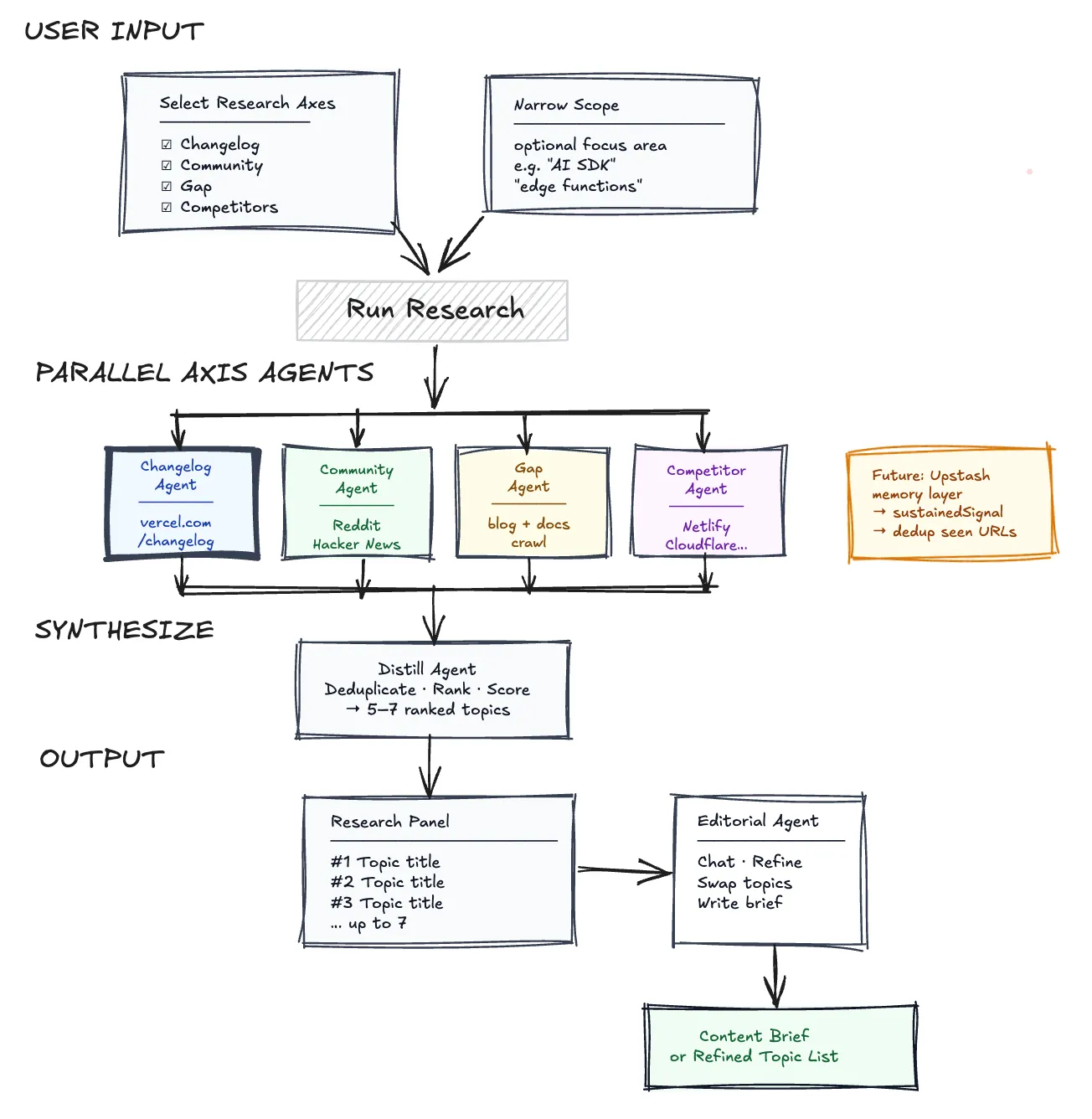
A multi-agent system that surfaces ranked content opportunities from four live signal sources — changelog releases that deserve a post, developer conversations on Reddit and Hacker News, competitor coverage gaps across deployment platforms and AI-native builders, and undercovered topics in the existing content archive — and produces ready-to-execute briefs with angle, hook, four-beat narrative arc, and title options. A distillation agent cross-references all four outputs and ranks by signal strength. A conversational editorial agent closes the loop. Designed to be adapted per client by swapping agent files.
Agentic Documentation Feedback Triage Pipeline
An autonomous two-agent system that runs on a schedule. Agent one analyzes incoming support tickets, identifies the documentation problem location, and writes structured findings to a shared log. Agent two searches the customer support wiki and other sources, constructs the documentation fix, applies the style guide as a generation constraint, and opens a branch and pull request with the corrected content ready for review. Gate logic stops the pipeline when agent one finds no real problem — keeping the CR queue trustworthy. Mandatory human review gate.